The cost of controlling psychopomps
The Dark HalfThe cost of controlling psychopomps is the limit Rawlie DeLesseps names after Thad Beaumont summons the sparrows: no one can command these agents of the afterlife for long, and control always exacts a price. The flock responds to Thad, but its purpose exceeds his grasp; its final arrival makes clear that the power he briefly claims is also a force capable of deciding the dead’s passage on its own terms.
The Summons and Its Apparent Power
At Gold’s Junkyard and Auto Supply, Thad and Rawlie discover the back ten acres of stacked cars and trucks carpeted with sparrows. The birds have arrived so silently that Thad did not hear a single one. They look toward him, not Rawlie, and remain still even when Rawlie claps his hands above his head. Their selective attention suggests a connection to Thad that is not simply a response to human movement or noise.
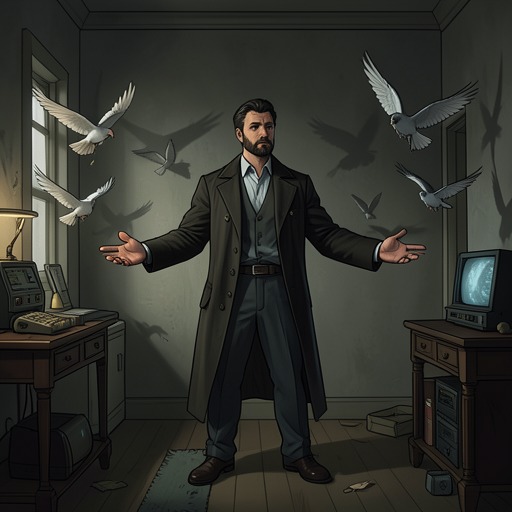
Thad speaks softly and tells them to find George Stark and fly. The flock rises in a black cloud, its wings making a sound like thunder thinned to lace, and banks westward as though taking up the direction he has given it. For a moment, the sight merges with the vision that marks the onset of Thad’s trances, binding his present encounter with the birds to the altered states that have preceded it. The summons looks like an act of command, but the birds’ uncanny arrival and coordinated departure leave open how much of their movement belongs to Thad’s will.
A Warning Against Ownership
Rawlie asks where the birds are going, and Thad knows he must follow. Before Thad leaves, Rawlie warns him that no one controls the agents of the afterlife for long and that there is always a price. The warning is not an abstract maxim: Thad has just seen the flock gather around him and obey his direction, but neither he nor Rawlie can explain what the birds mean or what their journey will cost.
As Thad drives away in Rawlie’s Volkswagen, he realizes the summons has given him a secret. He thinks he may own the psychopomps—or they may own him—and concludes that George Stark must not learn of the connection. That reversal turns apparent mastery into vulnerability: the power Thad intends to use against Stark also gives him something to conceal and places him within the birds’ mysterious reach.
The Birds’ Own Territory
The flock’s behavior elsewhere emphasizes that it does not simply submit to people. At the Williamses’ driveway, a sparrow lands on Alan Pangborn’s shoulder, hops onto his hand, and pauses with its beak poised as if to peck his palm. When Alan lowers his hand, it leaves without attacking. The encounter unsettles him, while the birds continue to stare; the surrounding trees are so full that a branch cracks under their weight.
Alan retreats up the driveway and sees the sparrows covering his car, but none have reached Lake Lane. He imagines the road as a staging area and notices a boundary between the birds’ presence and the space where he stands. Their capacity to approach, pause, and hold ground gives the flock a presence not reducible to a weapon at Thad’s disposal.
Thad encounters that boundary in another form when he stops his Volkswagen less than twelve feet from the flock. A sparrow lands on the hood and peers at him with what he senses as frightening, dispassionate curiosity. The birds have filled the road itself; reaching the house would mean driving over them. Thad’s urgent pursuit of Stark therefore brings him face to face with the material cost of the flock’s presence, not just the promise of its help.
The Price Revealed
At the final confrontation, Thad recognizes that the psychopomps have come to serve as Stark’s escort back to the land of the dead. The birds flood through the opening and settle on Stark’s shoulders, arms, and head; then they strike his chest in increasing numbers, with falling feathers and slashing beaks. Their action fulfills the deadly direction of Thad’s earlier summons, but the scene presents the flock as an overwhelming force rather than a controlled instrument.
The warning that no one can command the agents of the afterlife for long thus governs both Thad’s secret and the ending. He calls the birds to find Stark, yet their eventual role is not simply to execute a human order: they arrive as psychopomps, carrying Stark toward death. The cost of invoking them lies in the gap between summoning and ownership, and in the mortal consequence of a power whose agency Thad can neither fully explain nor securely contain.